How to Convert Word to PDF Online: Quick & Easy Guide
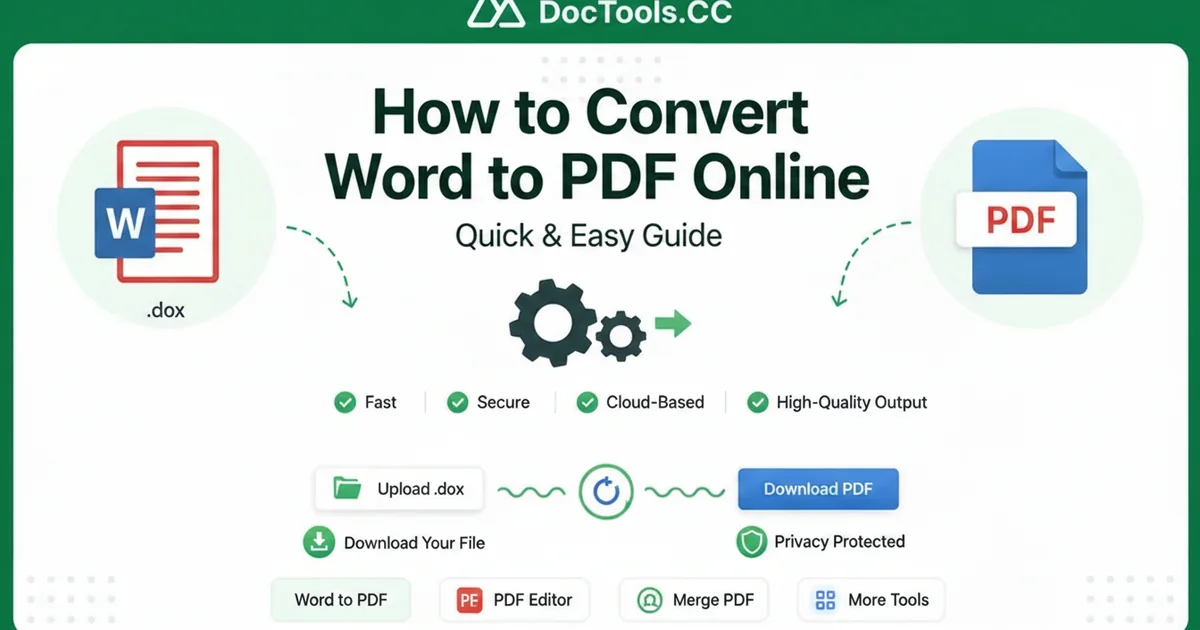
How to Convert Word to PDF Online: The Standard Method
Converting Word to PDF is one of the most common document tasks on the web — and for good reason. PDF files preserve your formatting exactly, making them reliable for resumes, contracts, reports, and anything else where consistent presentation matters across devices and operating systems.
Here's how to complete the conversion cleanly and efficiently:
Open your browser and navigate to a reputable online conversion tool that supports .docx and .doc input formats.
Upload your Word file by clicking the upload button or dragging and dropping the document directly into the conversion area.
Confirm the output format is set to PDF — most tools default to this automatically when you upload a Word file.
Click the Convert button and wait for the tool to process your file, which typically takes only a few seconds for standard documents.
Download your PDF once the conversion finishes, then open it to verify that fonts, spacing, tables, and images all rendered correctly.
Delete the uploaded file from the tool's server if the platform offers a manual delete option — a useful habit whenever sensitive documents are involved.
This process works for the vast majority of Word documents. However, complex formatting elements — such as embedded fonts, tracked changes, or advanced table styles — can occasionally shift during conversion, and so a quick visual check before sharing is always worth it. The biggest variable in this workflow isn't the steps themselves — it's which tool you use. Privacy policies, file size limits, and conversion quality vary significantly between platforms. That's exactly where your first real decision begins.
Step 1: Choose Your Conversion Tool Based on Privacy Needs
Before you drag a single file anywhere, picking the right word to pdf converter for your situation matters more than most people realize. Not every tool handles your document the same way — and the differences go beyond interface design.
The core question is: where does your file actually go? Some tools upload documents to remote servers, process them in the cloud, and may retain copies temporarily. Others process files locally in your browser, meaning your content never leaves your device. For sensitive contracts, financial records, or personal documents, that distinction is critical.
Here's how to evaluate your options before committing:
Identify your document's sensitivity level. A public-facing flyer needs far less protection than a signed legal agreement or employee record. Classify first, then choose a tool accordingly.
Check the tool's privacy policy for data retention. Look specifically for language about how long uploaded files are stored — reputable tools delete files within 24 hours or immediately after download.
Confirm the output format requirements. Some workflows require PDF/A for archiving, while others simply need a standard PDF. Not every converter supports both. As noted in [professional document management contexts](https://doctools.cc/blog/hidden-cost-of-simple-document-management), formatting integrity — including fonts and embedded images — must be preserved throughout conversion.
Test with a non-sensitive file first. Before processing anything confidential, run a placeholder document through the tool to verify output quality and confirm the download process works cleanly.
Bookmark your chosen tool. Switching converters mid-project introduces inconsistency in output formatting.
With the right tool selected, you're ready to move to the upload step — where secure file handling begins in earnest.
Step 2: Upload Your Docx or Doc File Securely
Once you've selected a tool that fits your privacy requirements, the next step is getting your file into the converter — and doing it correctly. When you convert docx to pdf, how you upload matters just as much as which tool you use.
Follow these steps to upload your document safely and set yourself up for a clean, accurate conversion.
Locate your file before opening the converter. Know whether you're working with a .docx (Word 2007 and later) or a legacy .doc file — some tools handle them differently, and confirming this upfront avoids surprises.
Open the converter's upload area in your browser. Most tools display a clearly labeled drop zone or an "Upload" button on the main interface.
Drag and drop your file directly into the drop zone, or click the upload button to browse your local folders. Avoid uploading files from a shared or public drive when the document contains sensitive information.
Verify the file name appears in the interface before proceeding. A visible filename confirmation means the tool has received your file and is ready to process it.
Check the file size limit — free tiers on many converters cap uploads at 5 MB to 25 MB. If your document contains high-resolution images, compress those assets beforehand to stay within the limit.
Confirm no account login is required if anonymity is a priority. Several reputable converters, including the option at [Drawboard](https://www.drawboard.com/tools/convert-docx-to-pdf), allow guest uploads without creating a profile.
With your file securely uploaded and confirmed, the converter is ready to process it — which is exactly where Step 3 picks up.
Step 3: Convert and Download Your New PDF File
With your file securely uploaded, you're ready to complete the core task — and understanding how to turn docx into pdf correctly at this stage prevents the most common output problems, like broken fonts or misaligned layouts.
Here is exactly what to do once your file is in the converter:
Confirm the output format is set to PDF before starting. Some tools default to other formats, so always verify the dropdown or selection panel shows "PDF" as the target.
Check any conversion settings available, such as page orientation, compression level, or password protection. Not every tool offers these, but when they do, and configuring them before converting saves you from repeating the process.
Click the Convert button and wait for the tool to process your file. Conversion typically takes under 30 seconds for standard documents, though larger files with embedded images may take longer.
Preview the output if the tool offers an in-browser preview. Scan at least the first page, last page, and any page with a table or image to catch formatting issues early.
Download the PDF to a known folder on your device. Avoid leaving it in a browser's default "Downloads" folder where files can be hard to locate later.
Delete your file from the tool's server if a manual deletion option exists. Privacy-focused converters like [Drawboard](https://www.drawboard.com/tools/convert-docx-to-pdf) auto-delete uploads, but confirming this step adds an extra layer of protection.
Once downloaded, open the PDF in any reader to verify the formatting held — pay close attention to headers, bullet points, and any embedded images. If something looks off, the issue is almost always a font compatibility problem from the original document.
One method that sidesteps many of these formatting concerns entirely is converting through Google Drive, which handles font rendering differently than browser-based tools — and that's worth exploring in detail next.
How to Convert Word to PDF Using Google Drive (Privacy Method)
Google Drive offers a surprisingly effective free docx to pdf converter path that keeps your file within an ecosystem you likely already trust. Because the conversion happens entirely within Google's infrastructure — rather than a third-party server you may know little about — it's a strong choice for documents containing sensitive information. No additional software installation is required.
Here's how to complete the conversion using Google Drive:
Open Google Drive in your browser and sign into your Google account if prompted.
Upload your .docx or .doc file by clicking the "+ New" button, then selecting "File upload" from the dropdown menu.
Wait for the upload to complete, then right-click the file in your Drive folder.
Select "Open with" → "Google Docs" to load the document in the browser-based editor. Google automatically renders the Word formatting within its own environment.
Navigate to File → Download → PDF Document (.pdf) from the Google Docs menu bar.
Save the downloaded PDF to your preferred local folder and verify the formatting is intact before sharing or archiving.
In practice, Google Docs handles most standard Word formatting well — headings, tables, and inline images typically carry over cleanly. However, documents with complex custom fonts or intricate layout elements may show minor shifts worth reviewing. Once you've confirmed the output looks right, your file is ready to use.
If you're dealing with more than one document, this method can feel repetitive. That's exactly where batch conversion becomes valuable — which the next section covers in full.
How to Convert Multiple Docx Files to PDF Simultaneously
When you need to convert Microsoft Word to PDF at scale — think end-of-quarter reports, client proposal packets, or a full folder of contracts — processing files one at a time wastes significant time. Batch conversion solves that problem cleanly.
In practice, the workflow depends on which tool you're using. Some tools cap batch uploads at 5 files; others, like DocTools.CC's batch processing features, handle up to 20 files at once and deliver everything as a single ZIP download, which eliminates repetitive clicking.
Here's how a typical batch DOCX-to-PDF workflow runs:
Gather your files into one folder on your desktop so they're easy to select in bulk.
Open the batch converter on your tool of choice and look for a multi-file upload option or a drag-and-drop zone that accepts multiple selections.
Select all target files at once using Shift+Click or Ctrl+A — most modern converters accept this input without requiring individual uploads.
Confirm file order if the tool displays a queue, removing any files that don't need converting before you proceed.
Start the conversion and wait for the tool to process each file; conversion time scales roughly with file size and server load.
Download the ZIP archive and extract your PDFs directly into your destination folder.
One caveat worth noting: complex formatting — tracked changes, embedded charts, custom fonts — can occasionally shift during batch conversion. Running a quick spot-check on a few output files before distributing them is always a smart habit. That layout question, in fact, is exactly what the next section tackles in depth.
How to Ensure Your PDF Layout Matches the Original Word Doc
Even the best online word to pdf converter free tool can produce a misaligned result if your source document isn't prepared correctly. Fonts shift, tables collapse, and images drift when underlying formatting isn't locked down before conversion. Follow these steps to protect your layout every time.
Embed all fonts before converting. If your Word doc uses custom or downloaded fonts, embed them via File → Options → Save → Embed fonts in the file. Without embedding, a converter substitutes system fonts, which alters line breaks and spacing.
Set explicit page margins. Open Layout → Margins and confirm measurements match your intended output. Inconsistent margins are the most common cause of content being clipped at PDF edges.
Anchor images and text boxes. Floating objects tied to a paragraph rather than the page tend to shift during conversion. Right-click each image, choose Wrap Text → In Line with Text, and the object stays fixed to its position.
Remove revision marks and comments. Go to Review → Accept All Changes, then clear comments. Hidden markup can subtly alter rendered page count and spacing in the final PDF.
Run a Print Preview check. Use File → Print → Print Preview in Word to see exactly what a PDF renderer will see. What shows here is what the converter processes.
Verify the result with a dedicated converter. Upload your prepared file to a reliable [document conversion suite](https://doctools.cc/tools/converters) and compare the output side by side with your original. Zoom in on tables, headers, and footers specifically — when available, areas carry the highest risk of drift.
A well-prepared source document is the single biggest factor in clean conversion output. With layout concerns handled, the next logical step is pulling together everything you've learned into a clear decision framework — which is exactly where the summary lands.
Summary: What You Need to Know About Online Conversion
Whether you need to convert multiple DOCX files to PDF for a client pitch or polish a single contract before sending, the process is simpler than most freelancers realize — once you know which steps matter. Here's a quick reference walkthrough to lock in a clean, reliable result every time.
Choose a privacy-conscious tool. Not every converter treats your documents the same way. Look for platforms that delete uploaded files automatically after processing — especially when handling sensitive contracts or proposals.
Prepare your source document first. Embed fonts, resolve tracked changes, and check that images are anchored correctly. A well-prepared DOCX produces a cleaner PDF output with fewer surprises.
Upload and confirm file settings. Select your file, verify the correct format is detected, and check any available quality or page-size options before you start the conversion.
Review the converted PDF immediately. Open the output file and scan for layout shifts, missing fonts, or broken page breaks. Catching issues now saves time later.
Save with a clear naming convention. Use a consistent format — client name, document type, date — so files stay organized, especially across large batches.
Store or send securely. If your workflow includes legally binding documents, consider pairing your converted PDFs with [properly structured legal templates](https://doctools.cc/tools/legal) to keep everything professional and consistent.
In practice, a streamlined conversion habit takes minutes to build but pays off across every project. Of course, managing your freelance paperwork goes well beyond the conversion step itself — which is exactwhere a broader document strategy becomes essential.
How to Manage Your Freelance Paperwork Beyond Conversion
Converting a DOCX to PDF is one piece of a larger document workflow. Once you've mastered that step, organizing the full paperwork stack — contracts, invoices, lien waivers, and client-facing deliverables — becomes the real productivity win.
Standardize your file naming before you convert anything. A consistent convention like
ClientName_ProjectType_MMDDYYYY.pdfprevents version confusion the moment a client asks for a resubmission.Convert every outbound document to PDF as a default, not an afterthought. Sending editable DOCX files to clients leaves formatting and content vulnerable to accidental changes.
Use purpose-built document generators for recurring paperwork. For example, if you work in construction or contracting, [ready-made lien waiver forms](https://doctools.cc/tools/construction) eliminate manual drafting entirely and output a clean PDF directly.
Automate utility tasks — encoding, hashing, or generating secure file links — with a dedicated toolkit rather than juggling separate browser tabs. A set of [free utility tools](https://doctools.cc/tools/utility) keeps those micro-tasks in one place.
Archive converted PDFs in a single folder per client or project. Flat folder structures beat deep hierarchies for fast retrieval.
Review your workflow quarterly. Tools improve, formats change, and a converter that worked last year may not preserve your updated template styles today.
Converting Word documents to PDF online is faster and more reliable than ever — but the real advantage comes from building it into a repeatable system. Start with a dependable converter, layer in the right document generators, and your freelance paperwork stops being a bottleneck.